The impeller diameter is a critical factor that significantly impacts the performance of a pump bowl. As a leading pump bowl supplier, we have witnessed firsthand how variations in impeller diameter can lead to substantial differences in pump efficiency, head, and flow rate. In this blog, we will delve into the influence of impeller diameter on a pump bowl's performance, exploring the scientific principles behind these relationships and providing practical insights for our customers.
Understanding the Basics of Pump Bowl and Impeller
Before we discuss the influence of impeller diameter, it's essential to understand the basic components of a pump bowl and the role of the impeller. A pump bowl is a crucial part of a centrifugal pump, which is designed to convert the mechanical energy of the impeller into hydraulic energy. The impeller, on the other hand, is a rotating component with vanes that imparts velocity to the fluid as it passes through the pump.
The impeller diameter refers to the outer diameter of the impeller. It is one of the primary design parameters that engineers consider when designing a pump. By changing the impeller diameter, we can adjust the pump's performance characteristics to meet specific application requirements.
Impact on Flow Rate
One of the most significant effects of impeller diameter on pump bowl performance is its impact on flow rate. Generally, as the impeller diameter increases, the flow rate of the pump also increases. This is because a larger impeller has a greater surface area and can move more fluid per revolution.
The relationship between impeller diameter and flow rate can be explained by the principles of fluid mechanics. According to the affinity laws, the flow rate (Q) of a pump is directly proportional to the impeller diameter (D) and the rotational speed (N) of the impeller. Mathematically, this relationship can be expressed as:
[ Q_1/Q_2 = D_1/D_2 ]
where ( Q_1 ) and ( Q_2 ) are the flow rates at impeller diameters ( D_1 ) and ( D_2 ), respectively.
For example, if we increase the impeller diameter of a pump by 10%, the flow rate will also increase by approximately 10%, assuming the rotational speed remains constant. This relationship is particularly useful for applications where a higher flow rate is required, such as in large-scale water supply systems or industrial processes.
Impact on Head
In addition to flow rate, the impeller diameter also affects the head of the pump. Head refers to the energy per unit weight of the fluid and is a measure of the pump's ability to lift the fluid to a certain height or overcome resistance in the system.
As the impeller diameter increases, the head of the pump also increases. This is because a larger impeller can impart more energy to the fluid, allowing it to reach a higher elevation or overcome greater resistance. The relationship between impeller diameter and head can also be described by the affinity laws:
[ H_1/H_2 = (D_1/D_2)^2 ]
where ( H_1 ) and ( H_2 ) are the heads at impeller diameters ( D_1 ) and ( D_2 ), respectively.

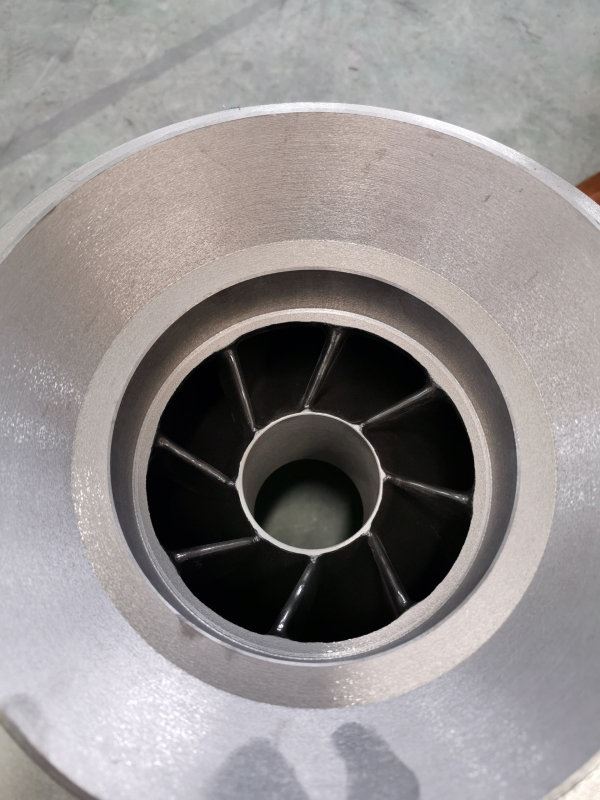
This means that a small increase in impeller diameter can result in a significant increase in head. For instance, if we double the impeller diameter, the head will increase by a factor of four. This property is crucial for applications where high head is required, such as in tall buildings or deep well pumping.
Impact on Efficiency
Efficiency is another important performance parameter of a pump. It represents the ratio of the useful power output of the pump to the power input. The impeller diameter has a complex relationship with pump efficiency.
In general, there is an optimal impeller diameter for a given pump design that maximizes efficiency. When the impeller diameter is too small, the pump may not be able to generate enough head or flow rate, resulting in low efficiency. On the other hand, if the impeller diameter is too large, the pump may consume more power than necessary, also leading to reduced efficiency.
The optimal impeller diameter depends on various factors, such as the pump design, the fluid properties, and the operating conditions. As a pump bowl supplier, we work closely with our customers to select the appropriate impeller diameter to ensure maximum efficiency and performance.
Practical Considerations for Customers
When selecting a pump bowl, customers should carefully consider the influence of impeller diameter on performance. Here are some practical tips:
- Determine the required flow rate and head: Before choosing a pump, it's essential to accurately determine the required flow rate and head for the application. This will help in selecting the appropriate impeller diameter.
- Consider the system characteristics: The characteristics of the piping system, such as pipe diameter, length, and friction losses, also affect the pump performance. Make sure to take these factors into account when selecting the impeller diameter.
- Consult with a professional: If you're unsure about the best impeller diameter for your application, it's advisable to consult with a pump expert or our technical team. We have extensive experience in pump selection and can provide you with personalized advice.
Our Pump Bowl Products
At our company, we offer a wide range of pump bowls to meet the diverse needs of our customers. Our Stainless Steel Bowl is made of high-quality stainless steel, which provides excellent corrosion resistance and durability. It is suitable for applications in harsh environments, such as chemical processing and seawater desalination.
We also offer Glass-Lined Bowl, which is ideal for applications where chemical resistance and purity are crucial. The glass lining provides a smooth surface that reduces friction and prevents the buildup of contaminants.
Conclusion
In conclusion, the impeller diameter plays a vital role in determining the performance of a pump bowl. By understanding the influence of impeller diameter on flow rate, head, and efficiency, customers can make informed decisions when selecting a pump for their applications. As a trusted pump bowl supplier, we are committed to providing high-quality products and professional technical support to help our customers achieve optimal pump performance.
If you have any questions about pump bowls or need assistance in selecting the right impeller diameter for your application, please feel free to contact us. We look forward to discussing your requirements and working with you to find the best solution.
References
- Stepanoff, A. J. (1957). Centrifugal and Axial Flow Pumps: Theory, Design, and Application. John Wiley & Sons.
- Karassik, I. J., Messina, J. P., Cooper, P. W., & Heald, C. C. (2008). Pump Handbook. McGraw-Hill.