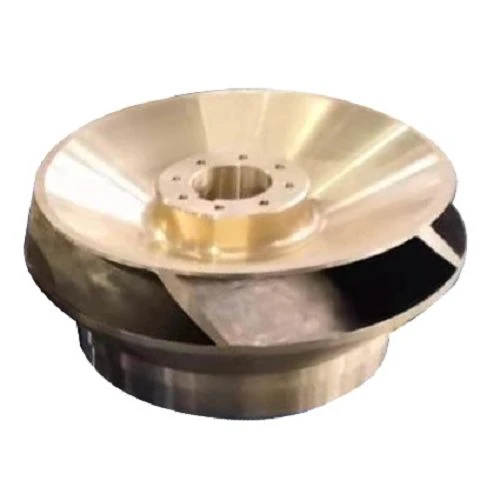
Hey there! As a supplier of Bronze Pump Impeller, I often get asked about the Young's modulus of a bronze pump impeller. So, I thought I'd write this blog to share some insights on this topic.
First off, let's talk about what Young's modulus is. In simple terms, Young's modulus, also known as the modulus of elasticity, is a measure of how stiff a material is. It tells us how much a material will stretch or compress when a force is applied to it. The higher the Young's modulus, the stiffer the material and the less it will deform under stress.
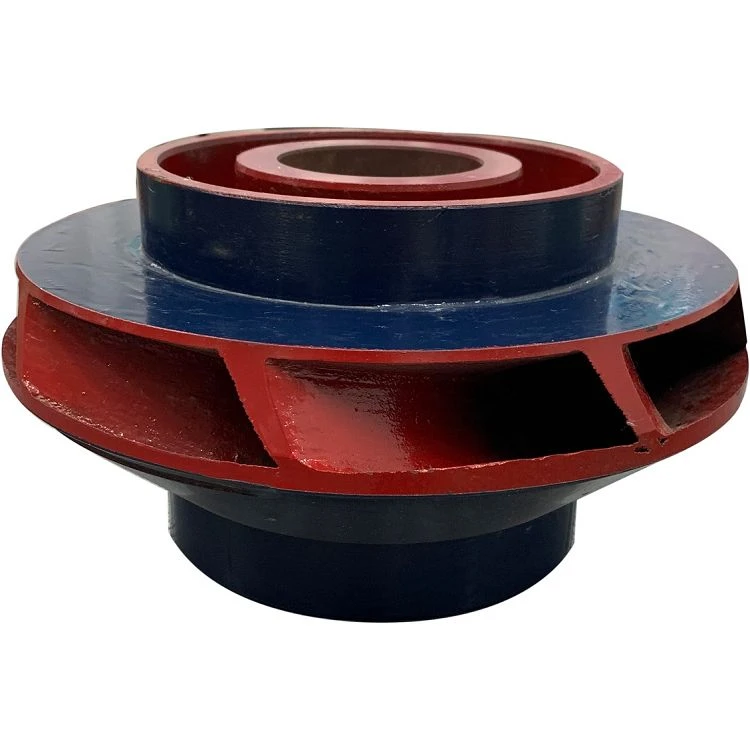
Now, when it comes to bronze pump impellers, the Young's modulus is an important property. Pump impellers are designed to rotate at high speeds and transfer energy to the fluid being pumped. This means they need to be strong and rigid enough to withstand the forces acting on them without deforming too much.
Bronze is an alloy made primarily of copper and tin, with small amounts of other elements like zinc, lead, or phosphorus. The exact composition of bronze can vary, which affects its mechanical properties, including the Young's modulus. Generally, the Young's modulus of bronze ranges from about 100 GPa to 120 GPa.
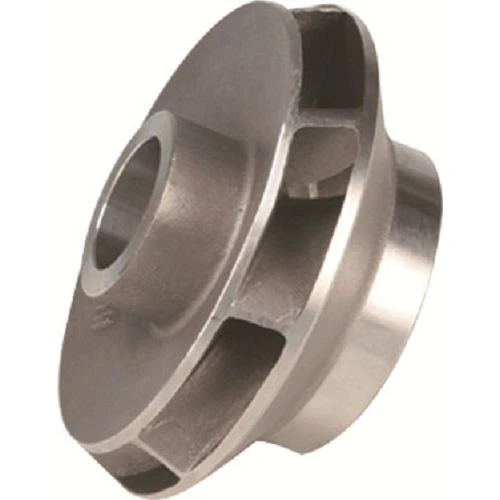
To put this in perspective, let's compare it with other materials commonly used for pump impellers. Cast Iron Pump Impeller typically has a Young's modulus of around 100 - 120 GPa as well, which is similar to bronze. On the other hand, Stainless Steel Pump Impeller has a higher Young's modulus, usually in the range of 190 - 210 GPa. This means that stainless steel is stiffer than bronze and cast iron, and will deform less under the same amount of stress.
But stiffness isn't the only factor to consider when choosing a material for a pump impeller. Other properties like corrosion resistance, strength, and cost also play important roles. Bronze is known for its good corrosion resistance, especially in water and marine environments. It also has a relatively high strength-to-weight ratio, which makes it a popular choice for pump impellers.
The manufacturing process of bronze pump impellers can also affect their Young's modulus. For example, casting is a common method used to make pump impellers. During the casting process, the cooling rate and the presence of any defects can influence the microstructure of the bronze, which in turn affects its mechanical properties. Heat treatment can be used to further improve the properties of the bronze, including its Young's modulus.
In practical applications, the Young's modulus of a bronze pump impeller is important for ensuring its proper performance. If the impeller is too flexible, it may deform under the forces generated during operation, leading to reduced efficiency and potentially causing damage to the pump. On the other hand, if it's too stiff, it may be more brittle and prone to cracking.
So, how do we measure the Young's modulus of a bronze pump impeller? One common method is the tensile test. In a tensile test, a sample of the bronze is pulled until it breaks, and the stress and strain are measured throughout the process. The Young's modulus is then calculated as the ratio of stress to strain in the elastic region (where the material returns to its original shape after the force is removed).
Another way to estimate the Young's modulus is through non-destructive testing methods, such as ultrasonic testing. Ultrasonic waves are sent through the material, and the speed at which they travel is related to the material's elastic properties, including the Young's modulus.
As a supplier of bronze pump impellers, we ensure that our products meet the required standards for Young's modulus and other mechanical properties. We use high-quality bronze alloys and advanced manufacturing processes to produce impellers that are strong, stiff, and reliable.
If you're in the market for a pump impeller, whether it's a bronze, cast iron, or stainless steel one, we can offer you a wide range of options. Our bronze pump impellers are designed to provide excellent performance and durability in various applications, from water pumping to industrial processes.
If you have any questions or are interested in purchasing our pump impellers, feel free to reach out to us. We'd be more than happy to discuss your requirements and help you find the right solution for your needs.
References:
- Materials Science and Engineering: An Introduction, by William D. Callister Jr. and David G. Rethwisch
- ASM Handbook, Volume 2: Properties and Selection: Nonferrous Alloys and Special-Purpose Materials